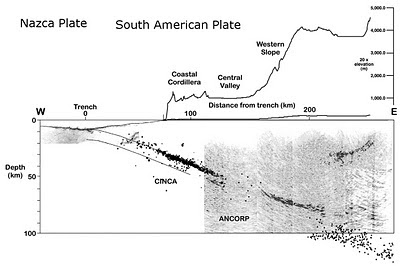
 Source: Allmendinger and González (2010)
Arica is a coastal city with approximately 190,000 residents located at 18° south latitude on the extreme northwestern edge of Chile. While historical earthquakes have indeed occurred within this region, little seismic activity has occurred here since 1877 because Arica resides within a seismic gap. This is generally not settling news since it represents a region where strain is and has been accumulating without release - meaning a considerable earthquake could hypothetically occur and Spence et al. (1999), and Berrocal et al (2004) have suggested that earthquakes in the late 1990s were precursors to a major event in the Arica 'elbow.' This is illustrated below as white ellipses, representing sections along the subduction zone that haven't experienced slip in the last century.
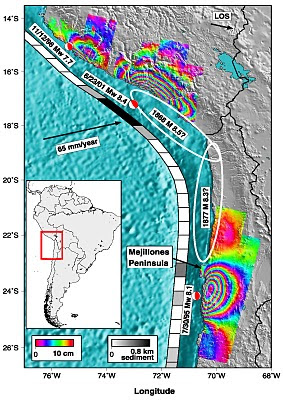 Source: Pritchard and Simmons (2006)
"as the only segment of the Chile-Peru Subduction Zone not to have ruptured within the last 100 years, the north Chile segment is now considered to be a region at high risk from an earthquake similar to, or larger than, the 1877 Tarapaca or Iquique earthquake (Mw 8.3)" - (Benfield 2010)
The last major event occurred in 1868 and completely leveled Arica and numerous coastal cities. This earthquake also produced a tsunami that added to both the local devastation and caused damage in New Zealand and Hawaii. This tsunami also left numerous ships stranded on land - similar to the events following the eruption of Krakatoa - such as the U.S. Wateree:
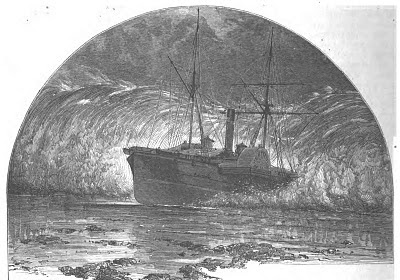 Source: Scribners Monthly
So I created some simple maps illustrating the tsunami inundation zone and historical earthquakes in the Arica region. To accomplish this I downloaded an inundation map produce by the Chilean Navy, exported the PDF as a tiff file and georeferenced it. Then I digitized the approximate boundary of the inundation zone and draped it over the topography (in relation to where I'm living and working) in ArcGIS and ArcScene to produce the following visualizations:

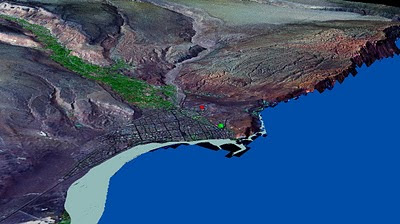 A simple 3D model illustrating how far both work and home are from the predicted inundation zone. The red flag represents the house, which is approximately 2.0 miles inland and the green flag is work and approximately 0.8 miles inland.
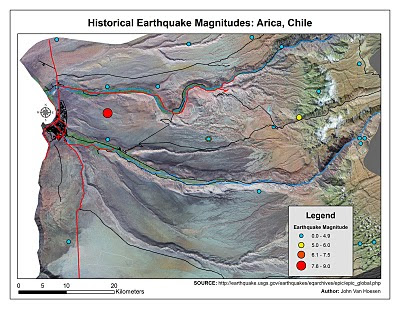
I created the earthquake magnitude maps by draping a Landsat image over a 30-m Aster-derived DEM and incorporating historical seismic data obtained from the USGS. This isn't very helpful other than illustrating how few earthquakes have occurred in this region since 1877. The large earthquake depicted in the center of the map represents the 1868 earthquake that caused so much devastation as depicted below:
 Source: U.S. Library of Congress
So, while the images are visually jolting there's no real way of predicting when an earthquake will occur so I won't - and hopefully friends and family won't - spend too much time worrying about what might happen. I would be more concerned if I was living in San Francisco given the height of their buildings; it is rare to find buildings over 3 stories in Arica and they are all downtown. I'm also confident that if an earthquake occurs that produces a tsunami, even if I'm within the inundation zone, I will have plenty of warning and time to flee the mile inland necessary to avoid harm. After living in Vermont for the last 7 years, I'm a little excited about living on an active margin and embrace all the possible processes that are at work beneath the city. So, to anyone out there who is worrying, don't!

 We stayed in Colby, Kansas for the night and awoke in the morning to a forecast that doubted whether we could get storms to form in Oklahoma before dark. But we decided to chance it. Storms fired very early (around noon) as we were just crossing the Oklahoma border. We finally reached a line of developing storms around 3pm. The cell we had targeted rapidly weakened as we approached near Chickasha, Oklahoma. As new storms developed to the southwest. We headed down interstate 44 towards Lawton, Oklahoma and then west. Reaching a high precipitation supercell near the Snyder, Oklahoma area in the Wichita Mountains area. Here is a quick preview from that storm!
  We stayed that night in Oklahoma City... and Saturday was supposed to be the big day. A rare 'high risk' of severe weather was issued by the Storm Prediction Center and they called for a tornado outbreak. We awoke early and crossed the Kansas border. Reaching the McPherson, Kansas area before heading west towards developing storms flying northeast across the state at 55mph. After being stuck in fog and low clouds on the early storms we elected to head to the south and west and get into clearer and more unstable air as more storms fired near Dodge City, Kansas and rapidly started to rotate. Here is a shot with a funnel cloud on the storm near Greensburg, Kansas! It ended up as a rather frustrating day as we would get in perfect positions on storms and they wouldn't produce. While the ones we had just left to the north had tornadoes on the ground, or another storm to the south would produce. Sometimes thats just the luck of chasing storms.
 Finally I'll sneak in one last photo from my trips to Badlands National Park (I'm working on an image account for this as well) Enjoy! Feel free to let me know what you think, and thanks for your patience as I complete all of these updates!
  Thanks again,Chris

 There was also a decent light show after dark!
  Then on May 2nd, I chased in Southern Nebraska where the cap finally broke just before dark. A supercell tried to wrap up above my head!
 Then I captured the best cloud to ground strike I had ever gotten on the way home!
  On May 3rd... I went out around sunset to timelapse some local convection, I also included a timelapse of the supercell developing near Fullerton the previous day. http://www.youtube.com/watch?v=PDiZ1RAS0TIMay 4th was a very frustrating day, where supercells tried to get going and constantly weakened right as we would get to them. Here is a quick shot of some mammatus from a dying storm and then a stack of lightning images after dark near Norfolk.
 May 5th was the worst day of the bunch... a strong cap stopped storms from developing and we basically got a tan with 1000 other chasers. That being said it was great to chat with friends and put some facebook faces to names in the real world. Ill keep you updated here as I get these accounts done! Thanks,Chris